

Model Kits
Kits of Figures, Vehicles, Artillery, Ships, Accessories, etc. by category.
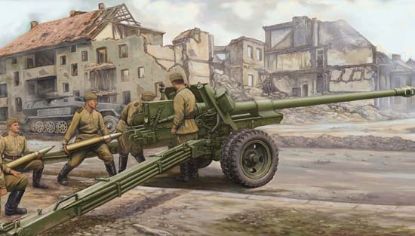
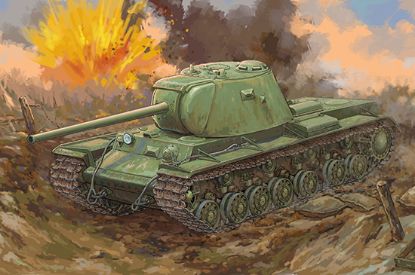
Russian KV-3 Heavy Tank
Trumpeter 09544
The KV-3 (Object 223) was an experimental Soviet heavy tank developed in 1941, based on the KV-220. It was designed to improve armor protection and firepower to counter new threats, including German tanks and anti-tank guns.
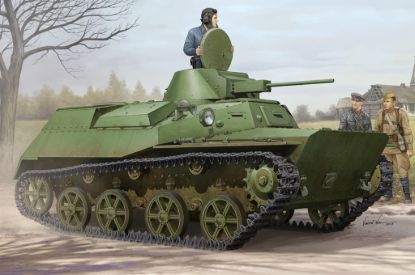
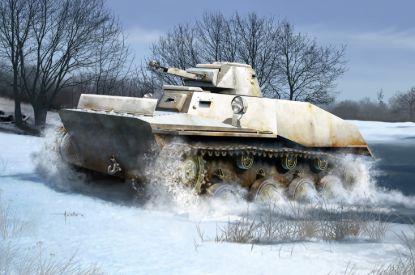
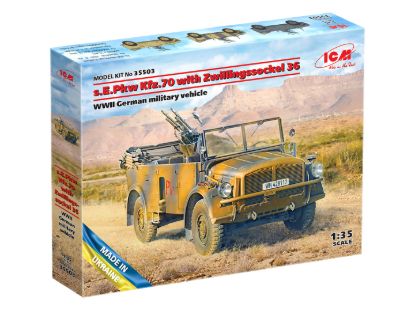
s.E.Pkw Kfz.70 with Zwillingssockel 36, WWII Germany Military Vehicle
ICM 35503
The Krupp Protze (Kfz.70 - Standard configuration for personnel carrying) was a six-wheeled 6×4 German truck and artillery tractor produced between 1934 and 1941 and heavily used in World War II. It was powered by a 4-cylinder, 55 hp or, from 1936, 60 hp Krupp M 304 petrol engine. Its main purpose was to tow artillery, especially the 3.7 cm Pak 36 anti-tank gun (designated Kfz 69), and transport motorized infantry (designated Kfz 70).
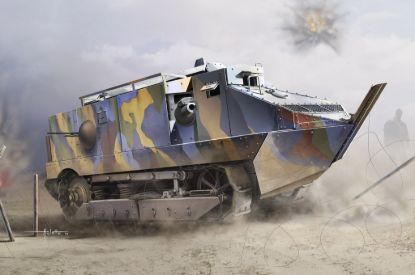
Schneider CA-Early
Hobby Boss 83861
The Schneider CA.1 was the first French tank, developed during the First World War.
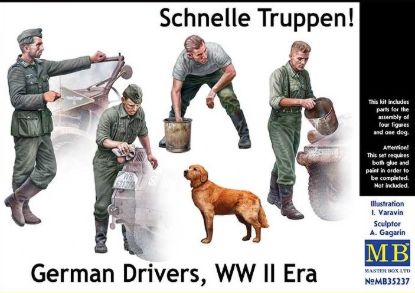
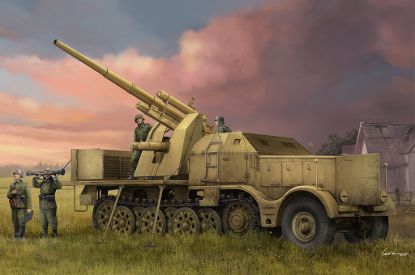
Schwerer Zugkraftwagen 18 t with 8.8cm Flak
Trumpeter 09577
8.8 cm Flak 18 anti-aircraft guns were mounted on fifteen Sd.Kfz. 9s in 1940 as the 8.8 cm Flak 18 (Sfl.) auf Zugkraftwagen 18t (Sd.Kfz. 9) for anti-tank duties. The crew and engine compartments were lightly (14.5 mm (0.57 in)), but completely, armored, which limited the gun's ability to fire directly ahead. A platform with drop-down sides was fitted for the gun. Outriggers were necessary to brace the platform sides to support the weight of the gun crew.
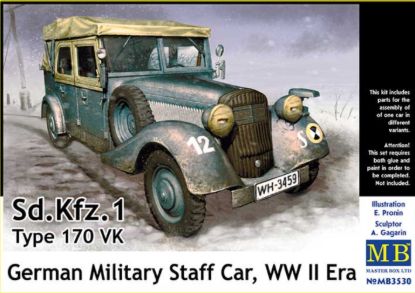
Sd. Kfz. 1 Type 170 VK, Germany Military Staff Car, WW II era
Master Box 3530
The Sd.Kfz. 1 Type 170 VK, also known as the Mercedes-Benz 170 VK, was a military vehicle adapted from the civilian 170V model. It was designed for military use, featuring a tough frame, flat surfaces, and off-road tires, making it suitable for rough terrain.
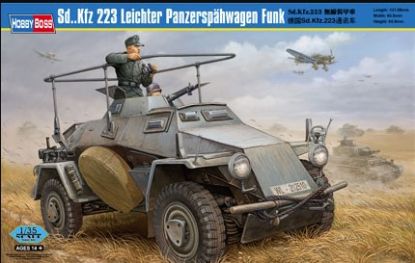
Sd..Kfz 223 Leichter Panzerspahwagen Funk
Hobby Boss 82443
The Sd.Kfz. 223 was Command and Communications vehicle, distinguished by its large collapsible aerial antenna frame above the gun emplacement. It featured a crew of three, including a driver, commander, and machine gunner. The Sd.Kfz. 223 was produced in 567 units from 1936 to January 1944, benefiting from its dedicated armored chassis and Horch V8 gasoline engine for cross-country travel. The vehicle's design was closely related to the Sd.Kfz. 221, with a stepped rear upper hull section and a tapered hatch covering the engine compartment. The Sd.Kfz. 223 was used for reconnaissance and communications missions, with its light armor protection and 4x4 wheeled design providing it with the necessary strength for military service.
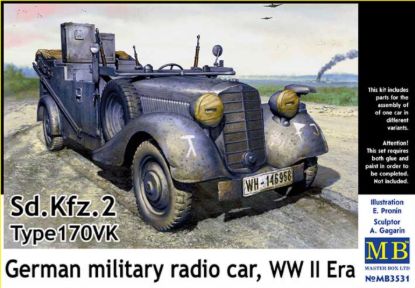
Sd.Kfz. 2 Type 170VK, Germany military radio car, WW II era
Master Box 3531
The Mercedes-Benz 170 VK exemplified the German Wehrmacht’s need for rugged, adaptable support vehicles during WWII. Its design balanced civilian comfort with military necessity, and its simplicity made it reliable in the field. Though not heavily armored or armed, some versions featured field adjustments or were used as staff cars. Though they were typically assigned to logistics units, signals detachments, and officer transportation roles.
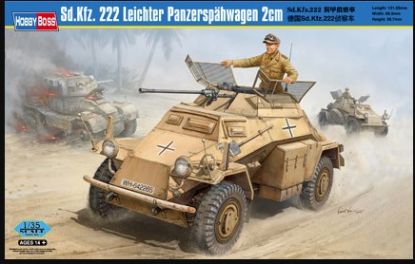
Sd.Kfz. 222 Leichter Panzerspahwagen 2cm
Hobby Boss 82442
The Sd.Kfz. 222's development and deployment were marked by its success in early campaigns against unprepared opponents, but it faced significant vulnerabilities when confronting well-equipped Allied forces. The vehicle's armor-piercing vulnerability was discovered during tests, leading to its eventual replacement by the Sd.Kfz. 234 Puma. The Sd.Kfz. 222's history is a testament to the complexities of armored vehicle development and the impact of engineering compromises on battlefield performance.