

Model Kits
Kits of Figures, Vehicles, Artillery, Ships, Accessories, etc. by category.
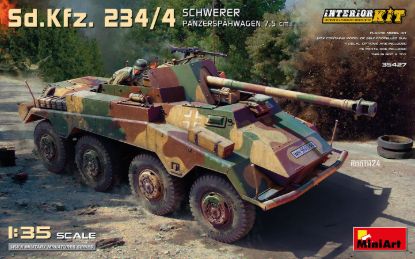
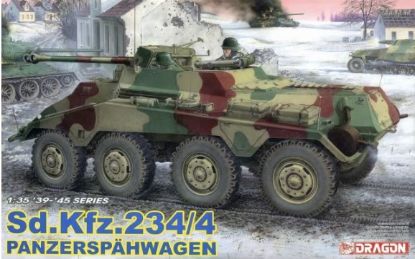
Sd.Kfz. 234/4 Schwerer Panzerspahwagen 7,5 cm. Interior Kit
MiniArt 35427
The SdKfz 234 Puma was a German eight-wheeled heavy armored car developed during World War II. After it was clear that a stronger armament was necessary to fight the Soviet tank units, the SdKfz 234/3 with a short 7.5 cm gun and then the SdKfz 234/4 with a long 7.5 cm Pak 40, which were rigidly mounted to the front in an open top stand, appeared. The Puma was primarily designed for reconnaissance missions, but its firepower (especially in the 234/2 variant) made it capable of engaging enemy light armor. Its excellent mobility and range allowed it to operate effectively behind enemy lines. The SdKfz 234 series represented the pinnacle of German armored car design during WWII, combining mobility, firepower, and reasonable protection. The diesel engine provided superior range compared to most contemporary vehicles.
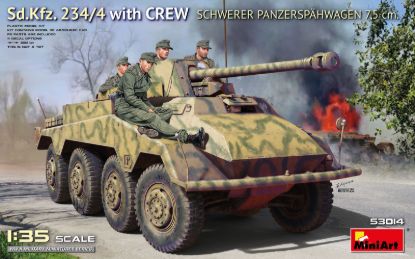
Sd.Kfz. 234/4 Schwerer Panzerspдhwagen 7,5 cm. w/Crew
MiniArt 53014
The SdKfz 234 Puma was a German eight-wheeled heavy armored car developed during World War II. After it was clear that a stronger armament was necessary to fight the Soviet tank units, the SdKfz 234/3 with a short 7.5 cm gun and then the SdKfz 234/4 with a long 7.5 cm Pak 40, which were rigidly mounted to the front in an open top stand, appeared. The Puma was primarily designed for reconnaissance missions, but its firepower (especially in the 234/2 variant) made it capable of engaging enemy light armor. Its excellent mobility and range allowed it to operate effectively behind enemy lines. The SdKfz 234 series represented the pinnacle of German armored car design during WWII, combining mobility, firepower, and reasonable protection. The diesel engine provided superior range compared to most contemporary vehicles.
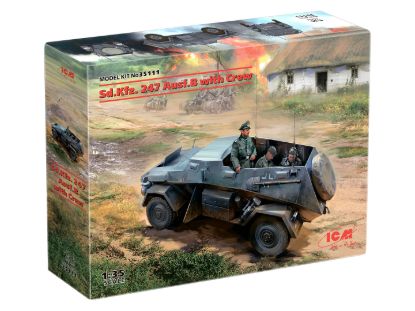
Sd.Kfz. 247 Ausf.B with Crew
ICM 35111
The Sd.Kfz. 247 Ausf.B was an armored command car used by the German armed forces during World War II. It was a four-wheeled model that entered production during the war, providing a mobile platform for senior German officers to travel safely across rough terrain. The Ausf.B was largely deployed on the Russian front and possibly in Normandy in 1944.
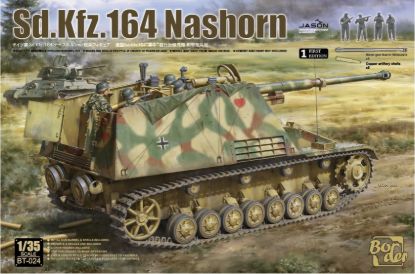
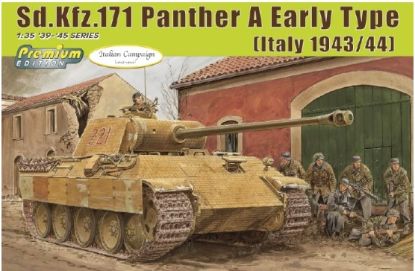
Sd.Kfz.171 PANTHER A EARLY PRODUCTION, ITALY 1943/44 (PREMIUM EDITION)
Dragon Models 6920
The Panther tank, officially Panzerkampfwagen V Panther (abbreviated Pz.Kpfw. V) with ordnance inventory designation: Sd.Kfz. 171, is a German medium tank of World War II. It was used in most European theatres of World War II from mid-1943 to the end of the war in May 1945.
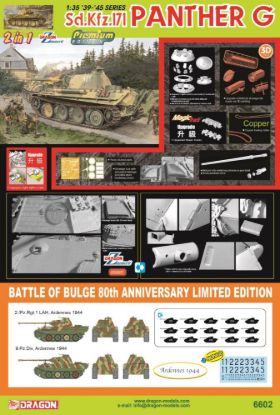
Sd.Kfz.171 PANTHER G (2 IN 1 - PREMIUM EDITION)
Dragon Models 6602
The Panther tank, officially Panzerkampfwagen V Panther (abbreviated Pz.Kpfw. V) with ordnance inventory designation: Sd.Kfz. 171, is a German medium tank of World War II. It was used in most European theatres of World War II from mid-1943 to the end of the war in May 1945.
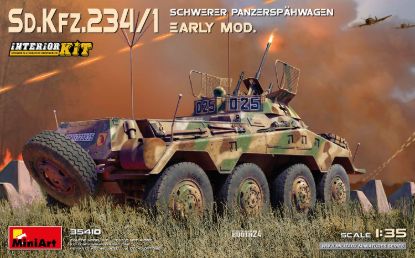
Sd.Kfz.234/1 Schwerer Panzerspähwagen (2 cm). Early Mod. Interior Kit
MiniArt 35410
The SdKfz 234 Puma was a German eight-wheeled heavy armored car developed during World War II. The basic model was the command armored car SdKfz 234/1 with an open top, fully rotatable hexagonal turret with 2 cm quick-fire cannon. The Puma was primarily designed for reconnaissance missions, but its firepower (especially in the 234/2 variant) made it capable of engaging enemy light armor. Its excellent mobility and range allowed it to operate effectively behind enemy lines. The SdKfz 234 series represented the pinnacle of German armored car design during WWII, combining mobility, firepower, and reasonable protection. The diesel engine provided superior range compared to most contemporary vehicles.
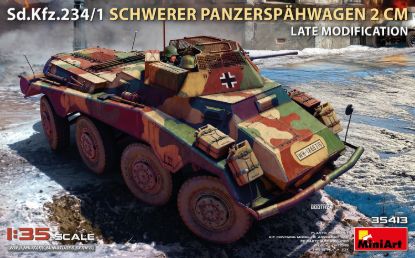
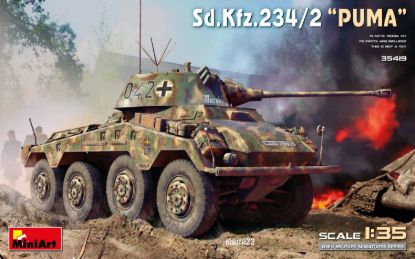
Sd.Kfz.234/2 “Puma”
MiniArt 35419
The SdKfz 234 Puma was a German eight-wheeled heavy armored car developed during World War II. The Puma was the SdKfz 234/2 with a turret shaped like a horse’s hoof from above with 5-cm-cannon was originally developed for the never put into service light main battle tank Leopard. The Puma was primarily designed for reconnaissance missions, but its firepower (especially in the 234/2 variant) made it capable of engaging enemy light armor. Its excellent mobility and range allowed it to operate effectively behind enemy lines. The SdKfz 234 series represented the pinnacle of German armored car design during WWII, combining mobility, firepower, and reasonable protection. The diesel engine provided superior range compared to most contemporary vehicles.
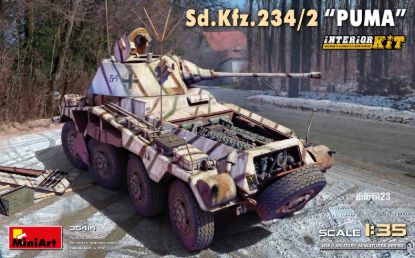
Sd.Kfz.234/2 “Puma”. Interior Kit
MiniArt 35414
The SdKfz 234 Puma was a German eight-wheeled heavy armored car developed during World War II. The Puma was the SdKfz 234/2 with a turret shaped like a horse’s hoof from above with 5-cm-cannon was originally developed for the never put into service light main battle tank Leopard. The Puma was primarily designed for reconnaissance missions, but its firepower (especially in the 234/2 variant) made it capable of engaging enemy light armor. Its excellent mobility and range allowed it to operate effectively behind enemy lines. The SdKfz 234 series represented the pinnacle of German armored car design during WWII, combining mobility, firepower, and reasonable protection. The diesel engine provided superior range compared to most contemporary vehicles.
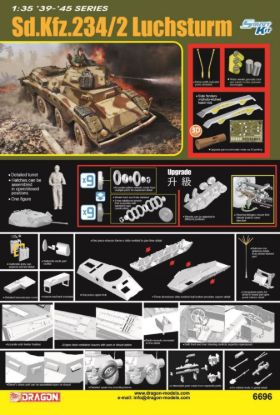
Sd.Kfz.234/2 LUCHSTURM
Dragon Models 6696
The SdKfz 234 Puma was a German eight-wheeled heavy armored car developed during World War II. The basic model was the command armored car SdKfz 234/1 with an open top, fully rotatable hexagonal turret with 2 cm quick-fire cannon. The Puma was primarily designed for reconnaissance missions, but its firepower (especially in the 234/2 variant) made it capable of engaging enemy light armor. Its excellent mobility and range allowed it to operate effectively behind enemy lines. The SdKfz 234 series represented the pinnacle of German armored car design during WWII, combining mobility, firepower, and reasonable protection. The diesel engine provided superior range compared to most contemporary vehicles.
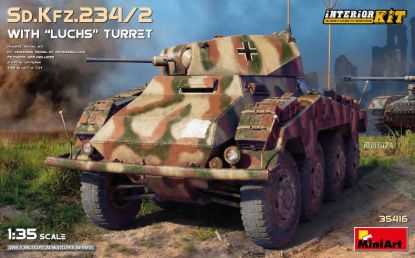
Sd.Kfz.234/2 with “Luchs” Turret. Interior Kit
MiniArt 35416
The SdKfz 234 Puma was a German eight-wheeled heavy armored car developed during World War II. The Puma was the SdKfz 234/2 with a turret shaped like a horse’s hoof from above with 5-cm-cannon was originally developed for the never put into service light main battle tank Leopard. The Puma was primarily designed for reconnaissance missions, but its firepower (especially in the 234/2 variant) made it capable of engaging enemy light armor. Its excellent mobility and range allowed it to operate effectively behind enemy lines. The SdKfz 234 series represented the pinnacle of German armored car design during WWII, combining mobility, firepower, and reasonable protection. The diesel engine provided superior range compared to most contemporary vehicles.
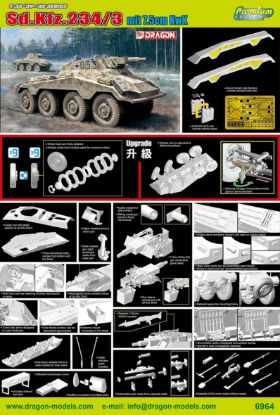
Sd.Kfz.234/3 mit 7.5cm KwK (PREMIUM EDITION)
Dragon Models 6964
The SdKfz 234 Puma was a German eight-wheeled heavy armored car developed during World War II. After it was clear that a stronger armament was necessary to fight the Soviet tank units, the SdKfz 234/3 with a short 7.5 cm gun and then the SdKfz 234/4 with a long 7.5 cm Pak 40, which were rigidly mounted to the front in an open top stand, appeared. The Puma was primarily designed for reconnaissance missions, but its firepower (especially in the 234/2 variant) made it capable of engaging enemy light armor. Its excellent mobility and range allowed it to operate effectively behind enemy lines. The SdKfz 234 series represented the pinnacle of German armored car design during WWII, combining mobility, firepower, and reasonable protection. The diesel engine provided superior range compared to most contemporary vehicles.
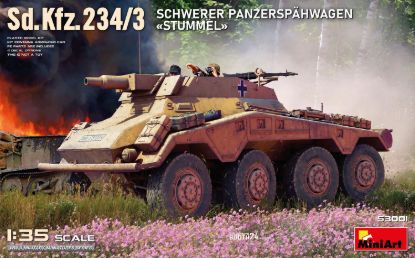
Sd.Kfz.234/3 Schwerer Panzerspähwagen «Stummel»
MiniArt 53001
The SdKfz 234 Puma was a German eight-wheeled heavy armored car developed during World War II. After it was clear that a stronger armament was necessary to fight the Soviet tank units, the SdKfz 234/3 with a short 7.5 cm gun and then the SdKfz 234/4 with a long 7.5 cm Pak 40, which were rigidly mounted to the front in an open top stand, appeared. The Puma was primarily designed for reconnaissance missions, but its firepower (especially in the 234/2 variant) made it capable of engaging enemy light armor. Its excellent mobility and range allowed it to operate effectively behind enemy lines. The SdKfz 234 series represented the pinnacle of German armored car design during WWII, combining mobility, firepower, and reasonable protection. The diesel engine provided superior range compared to most contemporary vehicles.
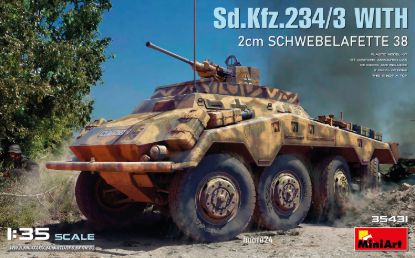
Sd.Kfz.234/3 with 2cm Schwebelafette 38
MiniArt 35431
The SdKfz 234 Puma was a German eight-wheeled heavy armored car developed during World War II. After it was clear that a stronger armament was necessary to fight the Soviet tank units, the SdKfz 234/3 with a short 7.5 cm gun and then the SdKfz 234/4 with a long 7.5 cm Pak 40, which were rigidly mounted to the front in an open top stand, appeared. The Puma was primarily designed for reconnaissance missions, but its firepower (especially in the 234/2 variant) made it capable of engaging enemy light armor. Its excellent mobility and range allowed it to operate effectively behind enemy lines. The SdKfz 234 series represented the pinnacle of German armored car design during WWII, combining mobility, firepower, and reasonable protection. The diesel engine provided superior range compared to most contemporary vehicles.
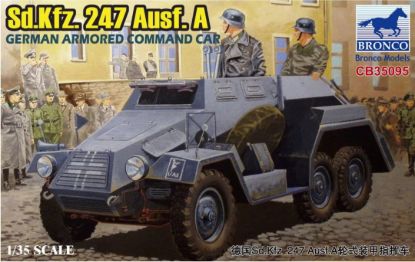
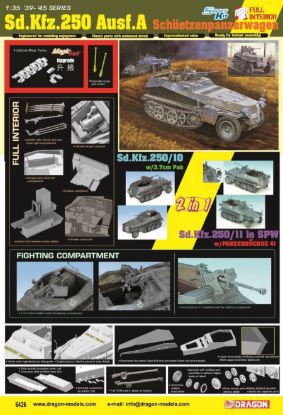
Sd.Kfz.250 Ausf.A SCHUETZENPANZERWAGEN (2 IN 1)
Dragon Models 6426
Sd.Kfz. 250/8 leichter Schützenpanzerwagen (7.5 cm) Support variant armed with a 7.5 cm KwK 37 L/24 gun and an MG 34.
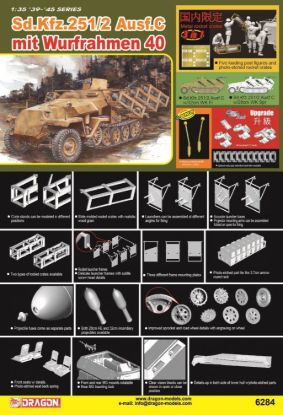
Sd.Kfz.251 Ausf.C mit WURFRAHMEN 40
Dragon Models 6284
This vehicle was a familiar sight, widely associated with the German infantry during all of World War Two. It began simply as an armored version of the Sd.Kfz.11 half-tracked artillery tractor. The half-track was one of the several solutions given to the problem of low off-road capabilities of trucks and associated “special purpose vehicles” (Sonderkraftfahrzeug). The Sd.Kfz.11 was designed in 1938 by Hanomag and was the prime mover for the 105 mm (4.13 in) LeFH howitzer and 37 mm (1.46 in) Flak 43, and 9000 units were built until 1945. This company was the natural choice to fulfill the next Waffenamt specification, which requested an armored vehicle capable of carrying a section of Panzergrenadiers and their equipment in order to keep up with the Panzer Divisions. Each German mechanized infantry corps was to be equipped with a hundred of these. The protection given had to be sufficient against small arms fire and artillery shrapnel, and armament should comprise two MG 34 machine-guns for defense and direct support. In German nomenclature it was classed as a Mittlere Schützenpanzerwagen (“Medium Assault Armored Vehicle”).
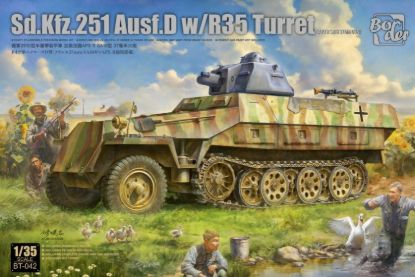
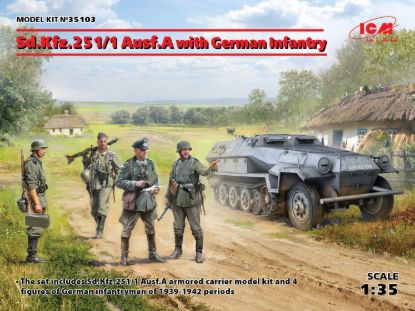
Sd.Kfz.251/1 Ausf.A with Germany Infantry
ICM 35103
The Sd.Kfz. 251/1, also known as the mittlere Schützenpanzerwagen (IR) Falke, was the standard German personnel carrier and a significant vehicle in the military history of World War II. It was designed to transport a squad of Panzergrenadiers to the battlefield, providing protection from small arms fire and artillery shrapnel. The vehicle was armed with two MG34 or MG42 machine guns for defense and direct support. The Sd.Kfz. 251/1 was used extensively by Nazi Germany during the war, particularly on the Eastern front, and later in the Western front.
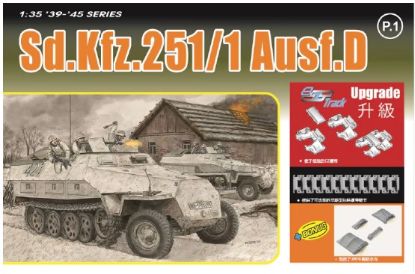
Sd.Kfz.251/1 Ausf.D
Dragon Models 6980
The Sd.Kfz. 251/1, also known as the mittlere Schützenpanzerwagen (IR) Falke, was the standard German personnel carrier and a significant vehicle in the military history of World War II. It was designed to transport a squad of Panzergrenadiers to the battlefield, providing protection from small arms fire and artillery shrapnel. The vehicle was armed with two MG34 or MG42 machine guns for defense and direct support. The Sd.Kfz. 251/1 was used extensively by Nazi Germany during the war, particularly on the Eastern front, and later in the Western front.
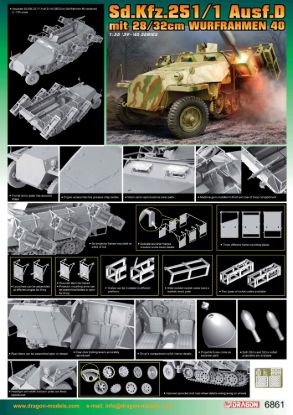
Sd.Kfz.251/1 Ausf.D mit 28/32cm WURFRAHMEN 40
Dragon Models 6861
The Sd.Kfz.251/1 II mittlerer Schützenpanzerwagen mit Wurfrahmen, was a heavy rocket launcher platform (also dubbed “Stuka zum Fuss”), equipped with six massive 28cm Sprengranate (HE rounds) or 32cm Flammgranate (incendiary rounds), the latter using napalm. They were called Wurfrahmen 40, and had a range of 1.9 and 2.2 km, respectively. First ordered in late 1940, these Wurfkoerper rocket launching vehicles only appeared by 1943-44 in limited numbers.